Explains why supply-air relative humidity can be higher even while the evaporator is removing moisture, and how duct leakage, damaged insulation, infiltration, airflow, and building pressure can contribute to indoor humidity problems.
One of the more confusing things about air conditioning is that the air coming out of a supply register can sometimes show a higher relative humidity than the air going into the system.
A homeowner sees 55% relative humidity in the house, puts a hygrometer near a supply register, sees 80% or 90%, and understandably asks:
“Is my air conditioner putting humidity into the house?”
In a normal cooling system, the answer is usually no.
The evaporator coil is actually doing the opposite. When it is operating correctly, it is removing moisture from the air.
The confusion comes from the word relative in relative humidity.
Temperature matters.
A lot.
And once you understand that, some strange-looking humidity readings start making much more sense.
Relative Humidity Is Not the Amount of Water in the Air
This is probably the most important part of the whole subject.
Relative humidity does not directly tell us how much water vapor is in the air.
It tells us how close the air is to saturation at its current temperature.
Warm air can contain more water vapor before reaching saturation than cold air can.
So if I take a sample of air and cool it down without adding any moisture, its relative humidity goes up.
The amount of water vapor may not have changed at all.
Only the temperature changed.
That means air can contain less actual moisture after passing across an evaporator coil while showing a higher RH percentage because it is much colder.
What the Evaporator Coil Is Actually Doing
When warm return air enters an air-conditioning system, it passes across the cold evaporator coil.
The coil removes two types of heat.
Sensible heat is what lowers the air temperature.
Latent heat is associated with removing moisture from the air.
When the evaporator surface is below the entering air’s dew point, water vapor begins condensing onto the coil.
You can see the result running down the coil and leaving through the condensate drain.
That water did not come from the air conditioner.
It came from the air inside the home.
The air conditioner removed it.
So imagine return air entering a system at roughly:
75°F and 60% RH
After passing across a cold evaporator, the leaving air might be near:
55°F with a much higher RH percentage
At first glance, that looks backward.
The air went across a coil that was supposed to dehumidify it, yet the RH reading increased.
But the leaving air is now much colder and much closer to its saturation point.
It can have less water vapor in it than the return air while still showing a higher relative humidity.
As that supply air enters the room and warms back up without gaining additional moisture, its relative humidity falls.
The air conditioner did not create humidity.
The temperature changed the percentage.
This Is Why Dew Point Matters
Relative humidity is useful, but sometimes dew point gives us a better picture of what is happening with moisture.
Dew point is the temperature at which the air would reach 100% relative humidity and water would begin condensing.
Unlike RH, dew point gives us a much better sense of the actual moisture level in the air.
That becomes especially useful when troubleshooting humidity complaints.
If I measure cold supply air and see a high RH number, I do not automatically assume something is wrong.
I want to know:
- What is the dry-bulb temperature?
- What is the relative humidity?
- What is the dew point?
- What were those same conditions before the air crossed the coil?
Those numbers together tell a much better story.
So Where Is the Humidity Coming From?
If the air conditioner is removing moisture but the house still feels humid, we need to look at the rest of the house.
The HVAC system does not operate in isolation.
The duct system, crawlspace, attic, building envelope, exhaust fans, doors, windows, and pressure differences all affect what the air conditioner is being asked to handle.
A perfectly functioning evaporator coil can only remove moisture from the air that actually passes across it.
If humid air keeps entering the house faster than the system can remove that moisture, indoor humidity can remain high even though the air conditioner itself is working.
That is where infiltration becomes important.
Infiltration Is a Latent Load
Infiltration is uncontrolled outdoor or unconditioned air entering the building.
During humid weather, every cubic foot of outside air that leaks into the home brings additional moisture with it.
That moisture becomes another load on the air-conditioning system.
Common infiltration paths can include:
- Plumbing and electrical penetrations
- Gaps around doors and windows
- Attic penetrations
- Crawlspace leakage
- Poorly sealed ductwork
- Building-envelope leakage
- Pressure imbalances created by exhaust systems or duct leakage
Sometimes the cooling system gets blamed for a humidity problem when it is actually fighting a constant source of moisture entering somewhere else.
The evaporator removes moisture.
The building lets more in.
The system removes more.
The building lets more in.
If the moisture entering exceeds what the equipment can remove during its normal runtime, the house stays humid.
Return Duct Leakage Can Make the Problem Worse
Return duct leakage is something I pay particular attention to when ductwork runs through a humid crawlspace, attic, or other unconditioned area.
When the blower is operating, much of the return duct system is under negative pressure.
If there are leaks in that ductwork, the system can pull surrounding air directly into the return.
Now imagine that return is running through a humid crawlspace.
Instead of only conditioning air from inside the home, the system may also be pulling warm, moisture-loaded crawlspace air into the duct system.
The air conditioner did not create that humidity.
The duct system delivered it to the coil.
That increases the latent load and can make indoor humidity control much more difficult.
Supply Duct Leakage Can Affect Humidity Too
Supply leakage works differently, but it can still contribute to the problem.
The supply side of the duct system is under positive pressure.
If conditioned air leaks into an attic, crawlspace, or other area outside the conditioned envelope, the house loses air that was supposed to remain inside.
That lost air has to be replaced from somewhere.
Depending on the pressure relationships in the home, replacement air may enter through cracks and openings in the building envelope.
During humid weather, that replacement air can bring moisture with it.
So a duct leak is not always just an energy-loss problem.
It can become a building-pressure and humidity problem too.
What Duct Insulation Has to Do With It
Duct leakage and duct insulation are related issues, but they are not the same thing.
Insulation helps control heat transfer between the air inside the duct and the environment surrounding it.
This becomes especially important with cold supply ducts running through hot, humid spaces.
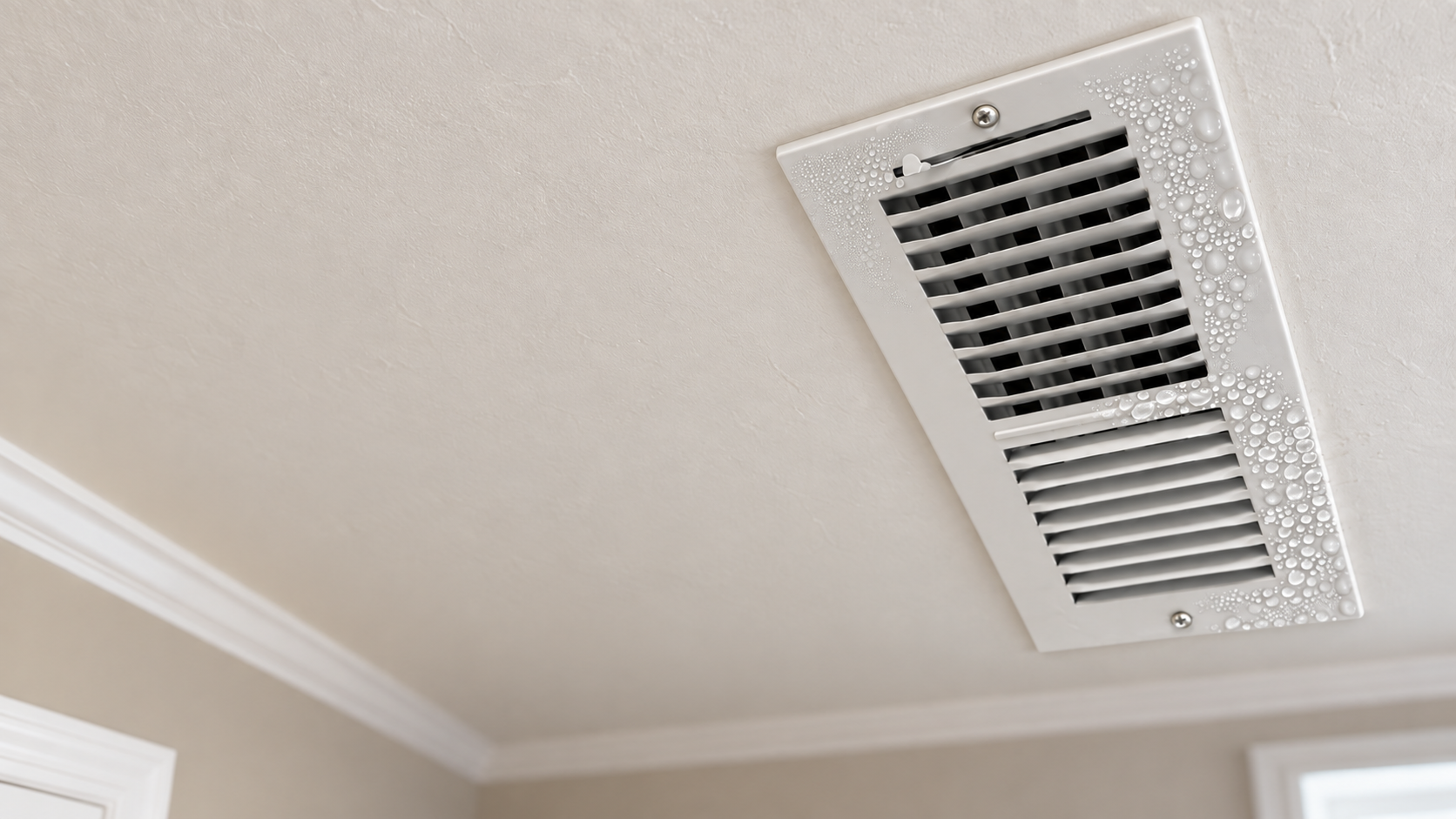
If the outside surface of that duct becomes colder than the dew point of the surrounding air, water will condense on it.
That is why supply ducts can “sweat.”
The duct is not producing water.
Water is not normally leaking through the sheet metal.
Moisture in the surrounding air is simply contacting a surface that is cold enough to bring that air below its dew point.
The same thing happens to a cold drink sitting outside on a humid summer day.
The water on the outside of the glass did not come through the glass.
It came from the surrounding air.
The duct is doing the same thing.
Damaged Insulation Can Turn Into a Bigger Problem
If duct insulation is missing, compressed, damaged, poorly sealed, or already wet, the situation can get worse.
Once insulation becomes wet, its insulating ability can decrease.
The outer surface can remain colder.
More condensation may occur.
Wet insulation can also hold moisture against the duct and surrounding materials for long periods of time.
Depending on the environment, that can contribute to:
- Water staining
- Damaged ceilings or building materials
- Corrosion
- Wet crawlspaces
- Deteriorated insulation
- Microbial growth concerns
- Higher cooling loads
So when I see condensation on ductwork, I do not just look at the air conditioner.
I want to know what the dew point of the surrounding space is and whether the duct insulation and vapor barrier are doing their jobs.
The Blower Can Put Some Moisture Back Into the Air
There is one important nuance when saying that an air conditioner does not create humidity.
The evaporator can remain wet after the compressor shuts off.
If the indoor blower continues operating, some of that water can evaporate back into the airstream.
That is one reason continuous-fan operation can sometimes hurt humidity control during cooling season.
The system still did not manufacture new moisture.
It removed moisture from the air, collected some of it on the evaporator, and then allowed a portion of that same moisture to re-evaporate before it drained away.
That is different from actually generating water vapor.
Equipment specifically designed to add moisture—such as a whole-house humidifier—is another story.
But a conventional cooling system does not normally create a new source of moisture.
High Indoor Humidity Does Not Automatically Mean the AC Is Bad
When I approach a humidity complaint, I do not want to immediately jump to:
“The air conditioner isn't dehumidifying.”
Maybe it isn't.
But there are several questions I want answered first.
Is the evaporator actually removing moisture?
Is condensate draining?
What are the entering and leaving air conditions?
What is happening to dew point across the coil?
Is airflow appropriate?
Too much airflow can reduce latent performance because the air spends less time interacting with the cold coil.
Too little airflow creates its own problems and can drive the evaporator temperature too low.
Airflow has to be considered as part of the whole system.
Is the equipment running long enough?
A system that satisfies the thermostat extremely quickly may remove sensible heat faster than it removes enough latent heat.
Humidity control depends partly on runtime.
Is humid air entering from somewhere else?
This is where I start thinking about:
duct leakage, crawlspaces, attics, building pressure, exhaust fans, air sealing, and the building envelope.
Sometimes the equipment is doing exactly what it is supposed to do.
The house is simply giving it more moisture than it can keep up with.
Don't Diagnose Humidity From One Hygrometer
Another thing I have learned from dealing with humidity complaints is how much measurement location matters.
A sensor directly in cold supply air may show very high relative humidity.
A thermostat across the room may show something completely different.
A crawlspace may have another RH entirely.
Those readings can all be correct.
They are measuring air at different temperatures and potentially different moisture contents.
That is why I try not to let one percentage become the entire diagnosis.
If I am really trying to understand a moisture problem, I want to know the temperature and humidity together.
Then I can start thinking in terms of dew point and actual moisture movement.
The House and the HVAC System Have to Be Looked at Together
This is probably the biggest thing I have taken away from the humidity calls I have been dealing with.
It is easy to think of the air conditioner as the thing responsible for the number on the thermostat.
But humidity control is a building problem as much as it is an HVAC problem.
The evaporator can remove moisture.
But the duct system can bring humid air back in.
The building envelope can leak.
A crawlspace can introduce moisture.
Exhaust fans can change building pressure.
Damaged duct insulation can allow condensation.
And equipment operation can affect how much latent heat the system removes.
Everything is connected.
That is why sometimes the answer to:
“Why is my house still humid?”
is not:
“Your air conditioner is making humidity.”
It may be:
“Your air conditioner is removing moisture, but we need to figure out where the moisture keeps coming from.”
The Takeaway
A cold supply register showing a high relative-humidity percentage does not mean the air conditioner is blowing moisture into the house.
Relative humidity changes with temperature.
The evaporator can remove actual water from the air while the colder leaving air shows a higher RH percentage.
If indoor humidity remains high, the next step is to look at the whole system.
Airflow.
Runtime.
Duct leakage.
Duct insulation.
Infiltration.
Building pressure.
Crawlspace or attic conditions.
Dew point.
The air conditioner can only remove the moisture that reaches its evaporator.
If the house keeps supplying more, we have to find out where it is coming from.
And that is why, when I see a humidity problem, I am becoming less interested in one RH number and more interested in understanding how moisture is actually moving through the house.

Community discussion
Join the discussion.
Sign in with Google to contribute. Comments and replies appear immediately, so keep the conversation useful, respectful, and focused on the trade.
Loading comments…
No approved comments yet. Share a thoughtful question, observation, or field lesson below.
Leave a comment
Share what you’re learning.
Your Google email address is not posted or stored with the comment. Your display name and message become public immediately.
A Google account is required to reduce spam and keep comments accountable.
Your comment is now visible in the discussion.