A homeowner thought his furnace exhaust pipe was leaking water, but the real problem pointed toward leaking ductwork, high humidity, and condensation. This field case shows how dew point, surface temperature, and airflow can help explain where the water was really coming from.
The complaint sounded simple at first.
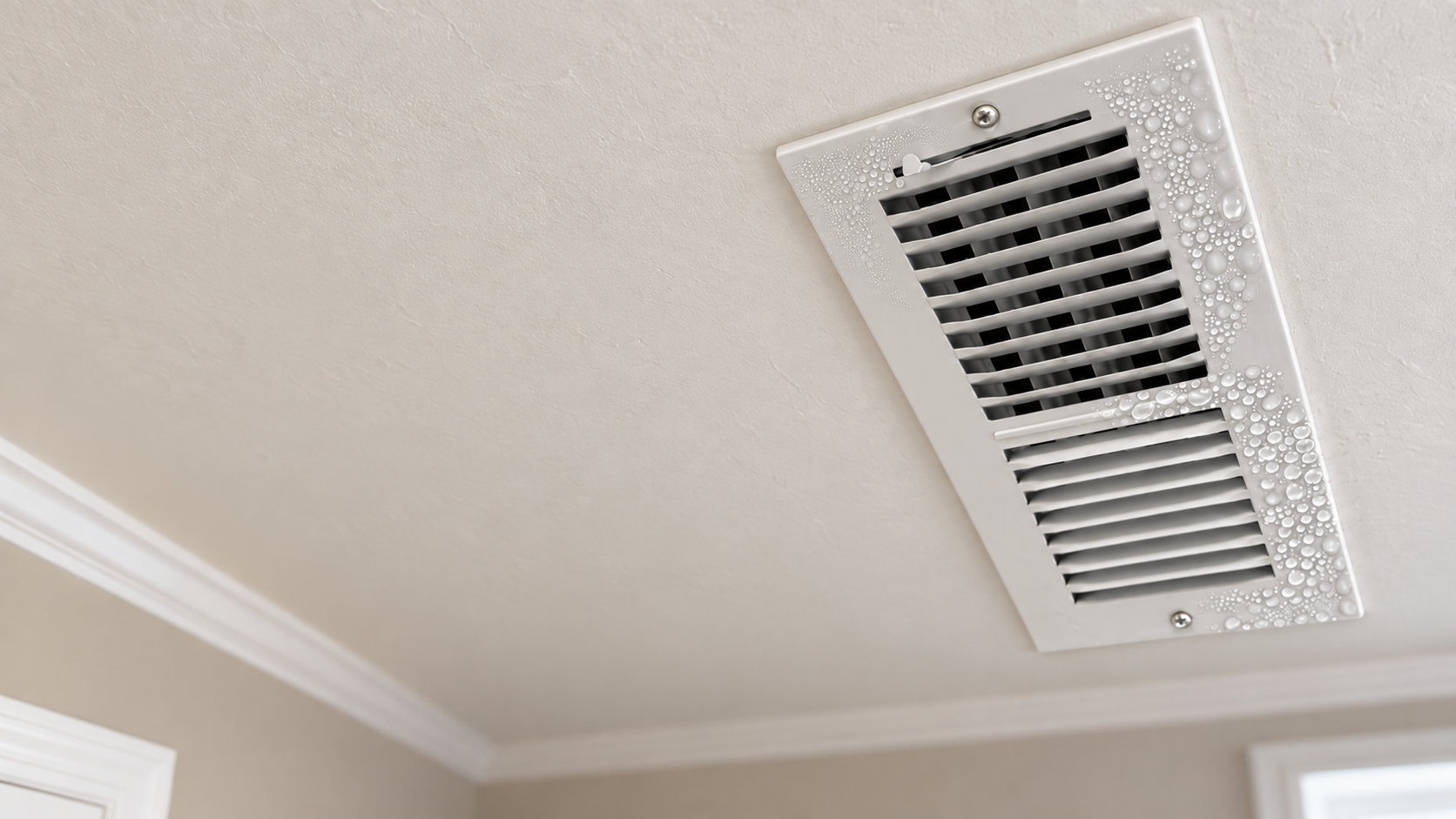
The homeowner had water dripping from the furnace vent pipe.
Enough water was collecting that he was putting a red Solo cup under the pipe and dumping roughly a cup of water out every day.
From his point of view, the furnace exhaust pipe was leaking.
That was the symptom.
The real question was whether the vent pipe itself was actually the source of the water.
This service call ended up being a good example of why HVAC diagnostics sometimes require looking beyond the equipment itself.
Temperature, humidity, airflow, duct leakage, and the building around the system all played a part in understanding what was happening.
The System and the Complaint
The home had a three-year-old York communicating HVAC system.
The furnace was located in a lower basement area, and the supply duct rose vertically through the home before connecting to the main trunk in the attic.
That duct system was built from ductboard.
The furnace vent also traveled through the same general chase on its way out of the house.
The homeowner had two main complaints:
- Water collecting around the furnace vent pipe
- Low airflow in the living room
At first, those sounded like two different problems.
They ended up pointing toward the same area of the system.
First I Wanted to Understand the Air
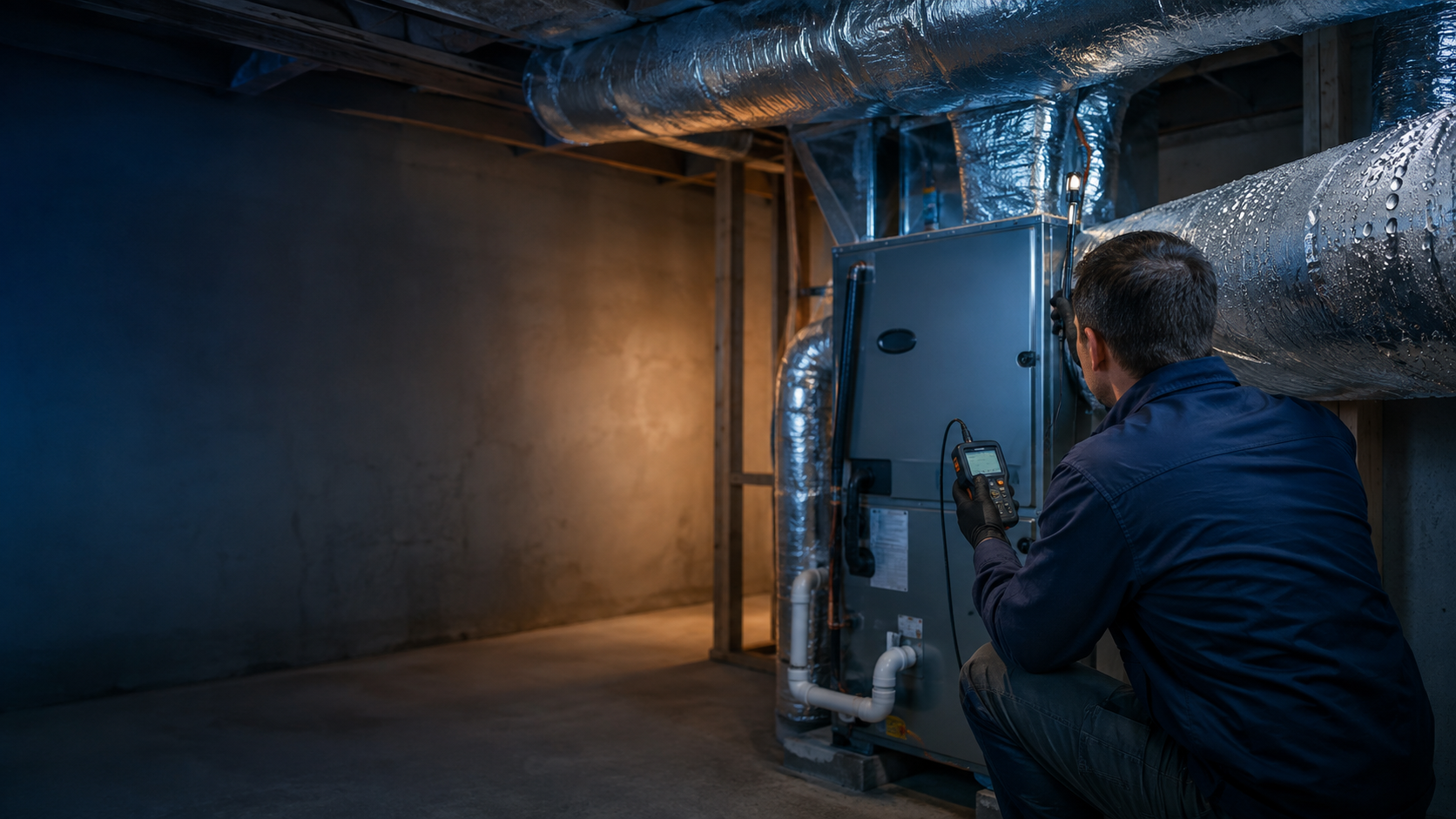
Before deciding where the water was coming from, I wanted to understand the conditions inside the home.
The ambient air in the furnace room measured approximately:
- 73.3°F dry bulb
- 65.5°F wet bulb
- 66% relative humidity
- 61.3°F dew point
- 30.4 Btu/lb enthalpy
Another ambient reading near the thermostat area was also around 66% relative humidity, with a dew point close to 59°F.
That told me the home had a relatively high moisture level.
For homeowners, dew point is simply the temperature at which moisture in the air can begin condensing into liquid water on a surface.
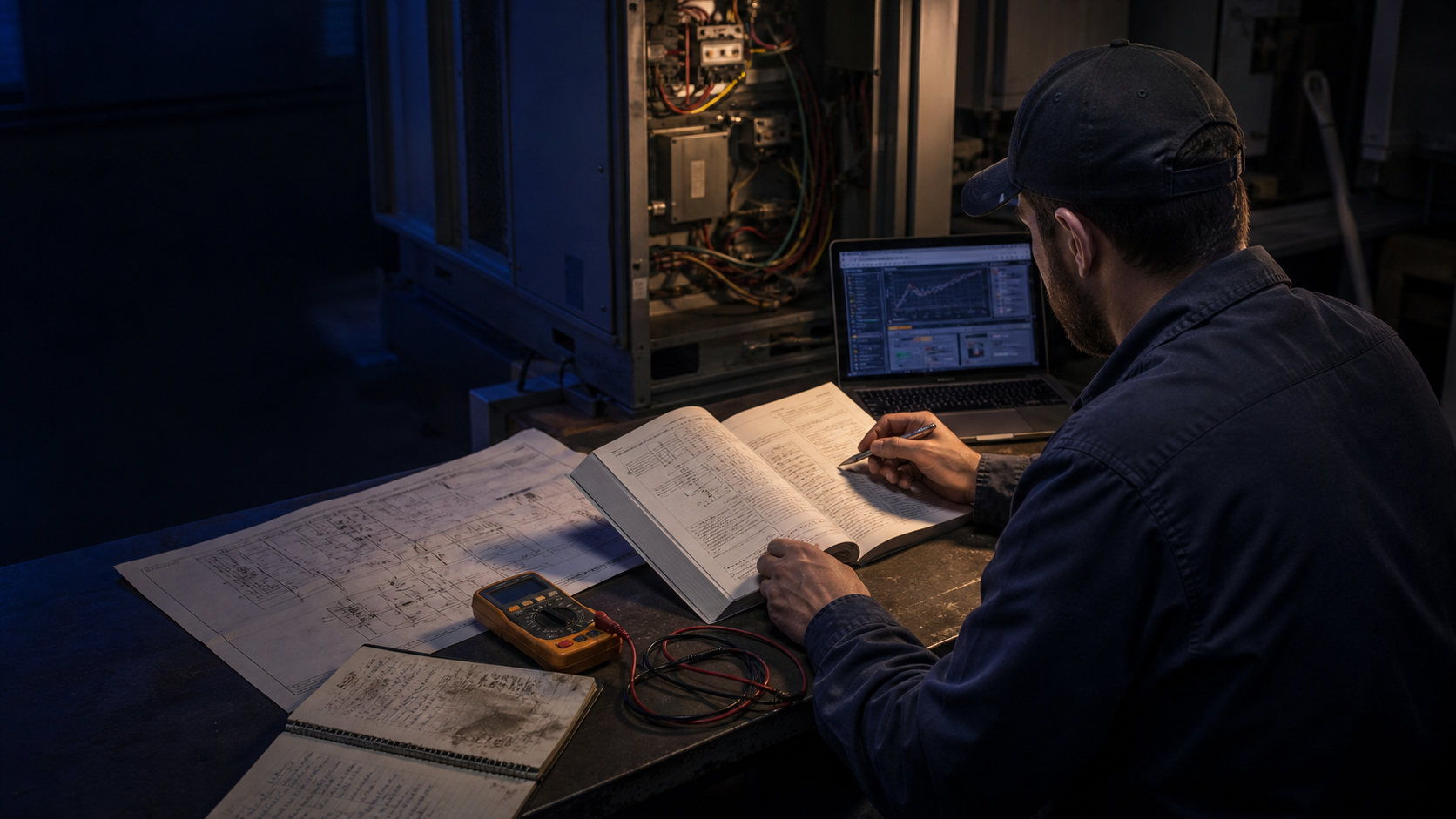
For technicians, this is where psychrometrics becomes useful in the field.
Psychrometrics is the study of the temperature and moisture properties of air.
Instead of just looking at relative humidity, we can look at dry-bulb temperature, wet-bulb temperature, dew point, enthalpy, and moisture content together to understand what the air is actually doing.
The Pipe Was Close to Dew Point
I also wanted to get an idea of the vent-pipe temperature.
I did not have a dedicated surface-temperature probe with me, so I placed a standard temperature probe against the galvanized metal.
The reading was roughly 64.5°F to 65°F.
That measurement needs some context.
A regular temperature probe touching sheet metal is not the same as a proper surface-temperature measurement.
Room air can influence the probe, the contact may not be perfect, and different areas of the pipe may be at different temperatures.
So I would not claim that the pipe was definitely below dew point based on that reading.
At the point I measured, the pipe appeared to be a few degrees above the furnace-room dew point of 61.3°F.
But it was close enough that I wanted to keep looking.
My First Suspect Was Cold Air Hitting the Pipe
There was already an opening in the supply-plenum area that was allowing cold conditioned air to escape near the vent.
My first thought was that the cold air might be cooling the galvanized pipe enough to create condensation.
That makes sense physically.
If cold conditioned air continuously blows across a metal surface, that surface can cool down.
If humid air then reaches that surface and the metal temperature is below the local dew point, water can form.
I sealed the obvious opening.
But after that, I could still feel cold air where I should not have been feeling it.
That told me the visible hole was probably not the whole problem.
I Still Had to Rule Out a Vent Problem
Before calling this a condensation issue, I still wanted to rule out an actual problem with the furnace vent.
I traced the vent through the attic and checked the roof termination from outside.
The cap was still in place, and I did not find anything obvious suggesting that rainwater was simply entering through the top.
The vent also appeared connected through the parts I could inspect.
That did not automatically prove every part of the vent system was perfect.
But it made rain intrusion less convincing as the explanation.
There was another important clue from the homeowner.
The water only showed up while the air conditioner was running.
That matters.
If rainwater were the main cause, I would not expect the problem to consistently follow cooling operation.
The fact that the water appeared during AC operation strongly suggested that the cooling system was part of the problem.
The Low-Airflow Complaint Led Me Back to the Ductwork
The homeowner also complained about weak airflow in the living room.
While I was in the attic, I looked over the duct system.
I found two flex runs coming directly off the end of the main trunk.
That was already something I wanted to keep in mind from an airflow standpoint.
But it still did not explain the amount of cold air I was feeling in the attic.
So I kept looking.
When I went back downstairs and felt around the vertical supply section again, I could still feel a significant amount of conditioned air escaping.
That sent me back into the attic.
This time I moved insulation away from the area where the vertical ductboard section connected to the attic trunk.
That is where the call started to make much more sense.
The Ductboard Was Leaking Badly
The vertical ductboard connection was leaking heavily.
I could not say with confidence that the ductboard had completely separated.
It may have been partially separating.
The tape or seal may have failed.
Or the connection may simply have been leaking badly around the joint.
What I could confirm was that conditioned air was escaping into the attic and chase area.
I could physically feel cold air where it did not belong.
I also found evidence of previous condensation around that area.
The furnace vent pipe traveled through the same general chase.
At that point, the pieces began to connect:
- High indoor humidity
- A vent pipe running close to dew-point conditions
- Cold conditioned air leaking into the attic
- Evidence of prior condensation
- A badly leaking ductboard connection
- Water showing up only while the AC was running
What I Believe Was Happening
This is where the psychrometrics become important.
Condensation needs two basic conditions:
A surface cold enough for condensation to occur
and
air containing enough moisture.
The leaking ductwork was providing the cold side of that equation.
Conditioned air was escaping from the supply system into the attic and chase instead of being delivered into the home.
That cold air could cool portions of the furnace vent pipe.
At the same time, the attic and chase contained warmer, more humid air.
That air supplied the moisture.
If any part of the vent surface dropped below the local dew point of the air around it, condensation could form.
The key word is local.
The 61.3°F dew point I measured was from the furnace-room ambient air.
I did not measure the dew point inside every part of the attic or chase.
The attic air could have had a higher dew point.
The backside of the vent pipe could also have been colder than the portion I was able to measure downstairs.
That means the available measurements supported the condensation theory, but they did not prove the exact temperature of every portion of the pipe.
One Pipe, Two Different Air Conditions
This was probably the most useful part of the call.
The vent pipe was sitting between two different air conditions.
On one side, leaking ductwork was exposing the pipe to cold conditioned air.
On the other side, attic and chase air were providing warmer, moisture-laden air.
The cold air lowered the surface temperature.
The humid air supplied the water vapor.
When the metal temperature drops below the dew point of the surrounding air, that water vapor becomes liquid water.
It is the same reason a cold glass of water sweats on a humid day.
The glass is not leaking.
The water is coming from the air.
Why the Red Solo Cup Matters
The amount of water was also important.
This was not just a few droplets on the vent pipe.
The homeowner was collecting roughly one Solo cup of water per day.
That told me the condition was repeating often enough to produce a meaningful amount of condensate.
It also matched the fact that the problem occurred during cooling operation.
Every time the AC ran, cold air was being lost into the wrong area.
If that leaking air repeatedly cooled part of the vent below the local dew point, condensation could form cycle after cycle.
Over an entire day, a slow drip can add up to a surprising amount of water.
The Duct Leak Was Causing More Than Condensation
The leaking ductwork did not only matter because of the water.
That conditioned air was supposed to be delivered into the home.
Instead, part of it was being dumped into the attic and chase.
That can contribute to:
- Reduced airflow at the registers
- Comfort complaints
- Longer run times
- Higher energy use
- Pressure imbalances
- Humidity problems
- Condensation in places where it should not occur
The homeowner had already complained about poor airflow in the living room.
The duct leakage provided a reasonable explanation for at least part of that complaint.
That is why I do not like treating duct leakage as only an efficiency problem.
It can affect the entire building.
Why the Humidity Level Mattered
The home was measuring around 66% relative humidity during my visit.
That matters because higher moisture levels generally raise the dew point.
The higher the dew point, the less a surface needs to cool before condensation can begin.
At 73.3°F and 66% relative humidity, the furnace-room dew point was approximately 61.3°F.
That means a surface exposed to that exact air would only need to fall into the low 60s before condensation became possible.
If the air in the attic or chase had an even higher dew point, the condensation threshold would be higher.
This is why humidity is not just a comfort number.
It directly affects when and where water can condense.
Relative Humidity Is Only Part of the Story
Relative humidity is useful, but it does not tell the entire story.
Relative humidity changes when air temperature changes.
That means two air samples can have similar relative humidity percentages while containing different amounts of moisture.
For condensation problems, dew point is often one of the most useful numbers because it gives us the temperature where water can begin forming on a surface.
For technicians, the important lesson is to look at the measurements together.
Dry-bulb temperature.
Wet-bulb temperature.
Relative humidity.
Dew point.
Surface temperature.
Airflow.
None of those measurements should be interpreted by itself.
The Thermostat Was Another Question
There was also another issue I noticed during the call.
The communicating thermostat appeared to be reading significantly different from a separate temperature measurement taken nearby.
The homeowner said the thermostat had already been replaced once.
Because this was a communicating York system, the thermostat is part of the equipment control strategy and cannot simply be treated like a basic conventional thermostat.
I do not believe the thermostat was the direct cause of the water around the vent.
But an inaccurate temperature reading can affect system runtime, comfort, and humidity control.
It was something I wanted evaluated separately instead of forcing it into the condensation diagnosis.
What I Recommended
The main issue I wanted corrected was the duct leakage.
There were two possible repair directions.
If the existing ductboard was still structurally sound, the leaking section could be properly repaired and sealed.
The other option was to replace the vertical ductboard section with properly fabricated metal duct and then seal and insulate it correctly.
Because this is intended to be the homeowner’s long-term home, I recommended seriously considering the metal-duct option.
The goal is not simply to replace ductboard because it is ductboard.
The goal is to create a duct system that is:
- Structurally sound
- Properly supported
- Properly sealed
- Properly insulated
- Able to deliver the intended airflow without dumping conditioned air into the attic or wall cavities
If the existing ductboard cannot reliably do that, replacing the problem section makes sense.
A Note About Ductboard
I am personally not a fan of ductboard in situations like this.
Ductboard can work when it is designed, fabricated, supported, sealed, and maintained correctly.
But damaged joints, failed tape, movement, moisture exposure, and deterioration can create difficult problems.
In this case, the vertical ductboard connection appeared to be a major part of the issue.
For a permanent repair, I would prefer properly fabricated metal duct that is sealed and externally insulated correctly.
That gives the system a more durable connection and gives future technicians something easier to inspect and service.
What I Would Measure on a Return Visit
If I returned after the repair, I would want to verify more than whether the red cup stopped filling.
I would want to compare:
- Indoor temperature and relative humidity
- Indoor dew point
- Attic or chase temperature and humidity
- Vent-pipe surface temperature at several locations
- Supply-air temperature
- Leakage around the repaired duct connection
- Airflow in the affected rooms
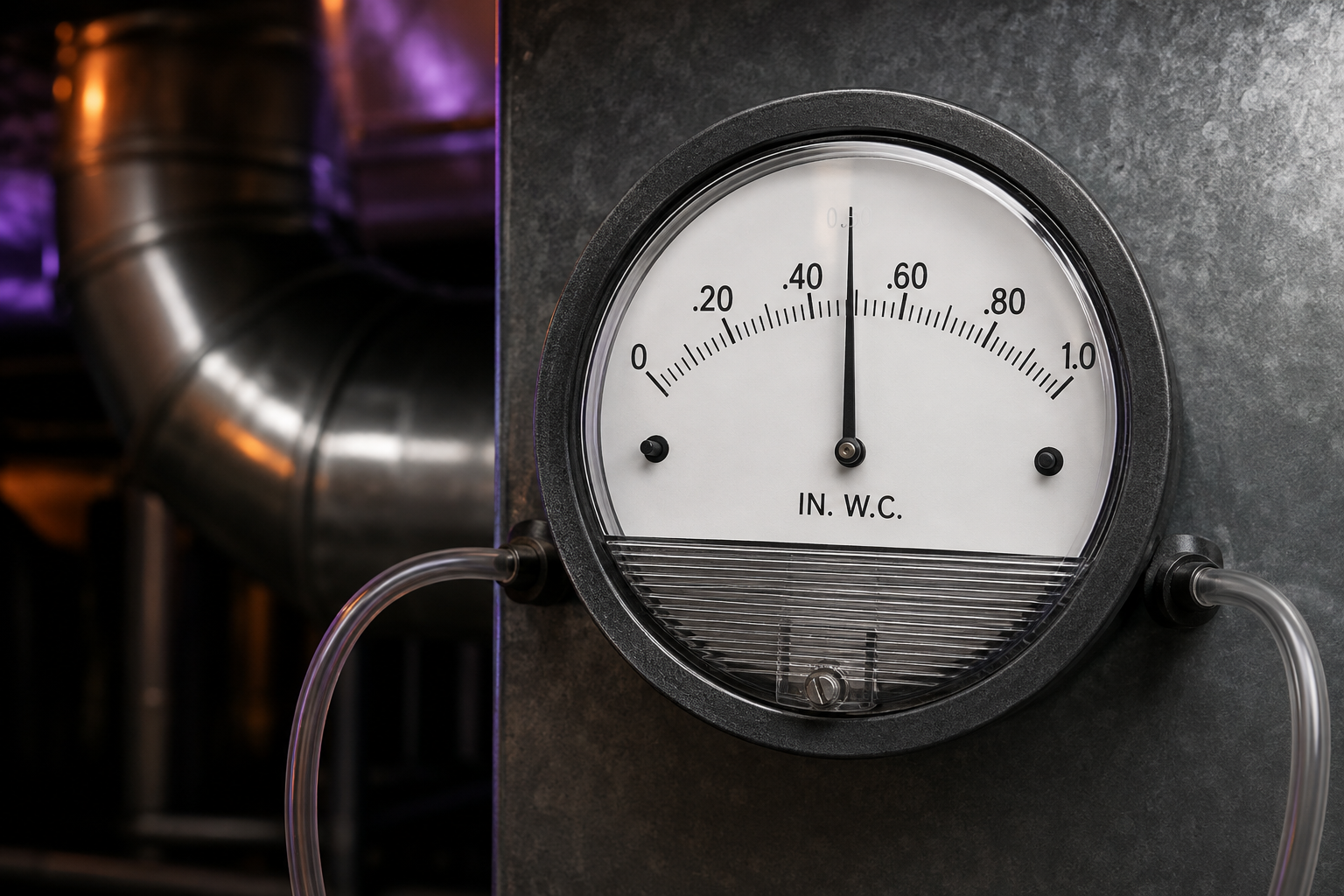
- Static pressure if needed
- Thermostat temperature against a trusted reference
That would help verify that the conditions creating the condensation had actually changed.
The absence of water is important.
Understanding why the water stopped is even better.
The Bigger Diagnostic Lesson
What I liked about this call was how easily the symptom could have pulled the diagnosis in the wrong direction.
There was water underneath the furnace vent.
It would have been easy to focus only on the vent.
But the evidence pointed toward a larger system problem.
The roof termination looked normal.
The water occurred during AC operation.
There was cold air in the attic.
The ductboard was leaking badly.
There was evidence of previous condensation.
The vent pipe passed through the same area.
Once those pieces were considered together, the condensation made much more sense.
The water showed me where the symptom ended.
It did not automatically tell me where the problem started.
The Takeaway
For a homeowner, the simple version is this:
The furnace vent pipe may not have been leaking at all.
Cold conditioned air was escaping from leaking ductwork into the attic and chase.
That cold air could cool the metal vent pipe.
Warm, humid air around the pipe could then condense on that colder surface.
For a technician, the lesson goes deeper.
Do not stop at relative humidity.
Do not stop at one temperature reading.
Do not stop at the place where the water shows up.
Look at the whole set of conditions:
Dry bulb.
Wet bulb.
Relative humidity.
Dew point.
Surface temperature.
Airflow.
Duct leakage.
The building around the equipment.
That is where psychrometrics becomes useful in the field.
Sometimes a complaint about a “leaking furnace vent” ends up teaching you more about ductwork, airflow, and moisture than it does about the vent itself.

Community discussion
Join the discussion.
Sign in with Google to contribute. Comments and replies appear immediately, so keep the conversation useful, respectful, and focused on the trade.
Loading comments…
No approved comments yet. Share a thoughtful question, observation, or field lesson below.
Leave a comment
Share what you’re learning.
Your Google email address is not posted or stored with the comment. Your display name and message become public immediately.
A Google account is required to reduce spam and keep comments accountable.
Your comment is now visible in the discussion.