Water around an AC vent does not always mean the system is leaking. Learn how humidity, dew point, duct insulation, air leakage, and surrounding attic or crawlspace conditions can cause supply vents to sweat.
Seeing water around an air-conditioning vent can be concerning.
You may notice droplets forming on the register, staining around the ceiling, damp drywall, or even water running down from the vent.
The first thought is usually:
“Is my air conditioner leaking water through the vent?”
Sometimes there really is a drainage or water problem that needs to be investigated.
But in many cases, the vent is not leaking water at all.
The water is forming on the outside of the vent because warm, humid air is coming into contact with a surface that is cold enough for condensation to form.
That is what people usually mean when they say an AC vent is “sweating.”
And understanding why it happens starts with one thing:
Dew point.
What Does It Mean When a Vent Is “Sweating”?
Think about a cold glass of water sitting outside on a humid summer day.
After a few minutes, water droplets start forming on the outside of the glass.
The water did not leak through the glass.
It came from the surrounding air.
The surface of the glass became cold enough that moisture in the air condensed on it.
An air-conditioning vent can do the same thing.
Cold supply air passes through the register, and the metal around it becomes cold.
If the air surrounding that vent contains enough moisture, and the surface temperature of the vent drops below the surrounding air’s dew point, condensation can begin to form.
Dew Point Is What Makes the Difference
Relative humidity gets most of the attention when homeowners talk about moisture, but dew point is extremely useful when we are trying to understand condensation.
Dew point is the temperature at which the air reaches saturation and water begins to condense.
For example, imagine the air in a room has a dew point of 62°F.
If the surface of the supply register stays above 62°F, you should not expect condensation from that room air.
But if the register surface falls below 62°F, moisture can begin forming on it.
That is why two homes can have similar-looking air-conditioning systems and only one has sweating vents.
The temperature of the vent matters.
But so does the amount of moisture in the surrounding air.
High Indoor Humidity Can Make Sweating More Likely
The more moisture there is in the indoor air, the higher the dew point tends to be.
That means the vent does not have to become as cold before condensation begins.
High indoor humidity can come from several places.
It may be related to:
- Outdoor air leaking into the home
- Humid crawlspaces
- Basement moisture
- Cooking
- Showers
- Poor ventilation
- Building-envelope leakage
- Duct leakage
- Equipment that is not removing enough moisture
This is why a sweating vent should not automatically be treated as a problem with the register itself.
Sometimes the cold vent is simply showing you that there is a larger humidity issue in the home.
The Register Boot May Not Be Properly Insulated
The part you can see inside the room is only one piece of the vent assembly.
Behind that register is usually a metal boot connected to the supply duct.
That boot can get very cold while the air conditioner is running.
If the boot is surrounded by a hot, humid attic, wall cavity, or crawlspace and it is not properly insulated, humid air can contact that cold metal.
Condensation can then form on the outside of the boot.
Eventually that water may travel down toward the visible register or soak into the surrounding ceiling material.
This can make it look like the water is coming from inside the air conditioner when the real problem may be taking place outside the duct.
If only one or two vents are sweating while the rest of the house looks normal, I would want to inspect the insulation around those individual boots.
Air Leakage Around the Vent Can Cause Problems Too
Insulation is only part of the story.
Air leakage around the boot can also matter.
Imagine a ceiling register installed below a hot, humid attic.
If there is a gap between the metal boot and the drywall, attic air may be able to move around that cold metal.
Now you have two things happening in the same place:
Cold metal
and
humid attic air.
That is exactly the combination needed for condensation.
Depending on pressure differences within the home and duct system, air may move through those gaps in different ways.
The important point for a homeowner is that the visible vent may not be the real problem.
The area around and behind it may need attention.
Damaged Duct Insulation Can Cause Sweating
Supply ducts are carrying cold air through parts of the building that may be much warmer and more humid.
That is why those ducts are insulated.
The insulation helps keep the outer surface of the duct warmer than it otherwise would be.
If the insulation is missing, torn, compressed, poorly installed, wet, separated at the seams, or has a damaged vapor barrier, the outer surface of the duct or boot may become cold enough for condensation to form.
Once insulation becomes wet, the problem can sometimes get worse.
Wet insulation may lose some of its insulating effectiveness and can remain damp for a long time.
That can lead to water staining, damaged ceiling material, corrosion, deteriorated insulation, and other moisture-related problems.
So if I see a sweating vent, I do not just look at the face of the register.
I want to know what the insulation looks like on the other side.
The Attic or Crawlspace May Be the Bigger Problem
Sometimes the ductwork itself is reasonably installed, but the environment around it is extremely humid.
This can happen in a damp crawlspace or a humid attic.
If the surrounding air has a high dew point, even well-insulated ductwork may have a harder time staying warm enough on the exterior to prevent condensation.
This is especially important in humid climates.
A crawlspace with exposed ground moisture, air leakage, drainage problems, or high outdoor humidity can become a major source of moisture.
The same is true of an attic that is communicating heavily with humid outdoor air.
The HVAC system may be operating correctly.
The duct may be carrying perfectly normal cold air.
But the environment around the duct can still create the conditions needed for sweating.
Very Cold Supply Air Can Increase the Risk
Cold supply air is normal.
That is how your air conditioner cools the house.
But if the air leaving the system becomes unusually cold, the metal ductwork and registers can become colder too.
That can make condensation more likely.
An unusually cold evaporator or low supply-air temperature can sometimes be associated with other HVAC issues, including:
- Low airflow
- Dirty filters
- Dirty evaporator coils
- Blower problems
- Refrigeration issues
- A coil beginning to frost
That does not mean every sweating vent has an airflow or refrigerant problem.
It simply means the supply temperature is one of the things a technician should consider.
Condensation or Water Coming Through the Duct?
This is one of the most useful distinctions a homeowner can make.
Signs That Point More Toward Condensation
You may be dealing with sweating if:
- Water droplets form on the outside of the register
- Moisture appears gradually while the AC is running
- The problem is worse during humid weather
- The metal vent feels very cold
- Staining is concentrated around the register
- Nearby insulation appears damp
- Only certain vents are affected
Signs That May Point to Another Problem
Further investigation is needed if:
- Water is actually dripping from inside the duct
- A large amount of water suddenly appears
- Water continues after the AC has been off for a long time
- The ceiling is wet well beyond the register
- The evaporator coil is freezing and thawing
- The condensate drain is overflowing
- There is a roof or plumbing leak nearby
A sweating register and a leaking condensate system can both put water near an AC vent, but they are not the same failure.
That is why identifying where the water is actually forming matters.
Could the Condensate Drain Be Involved?
Yes.
Your evaporator coil is designed to remove moisture from the air.
That water collects in a drain pan and leaves through a condensate drain.
If that drain becomes blocked, damaged, or improperly installed, water can overflow and show up in places where it should not.
Depending on where the air handler or furnace is located, condensate problems can sometimes look like duct condensation from inside the living space.
So if there is a significant amount of water, I would not assume it is just sweating without checking the drainage system.
What Should a Technician Check?
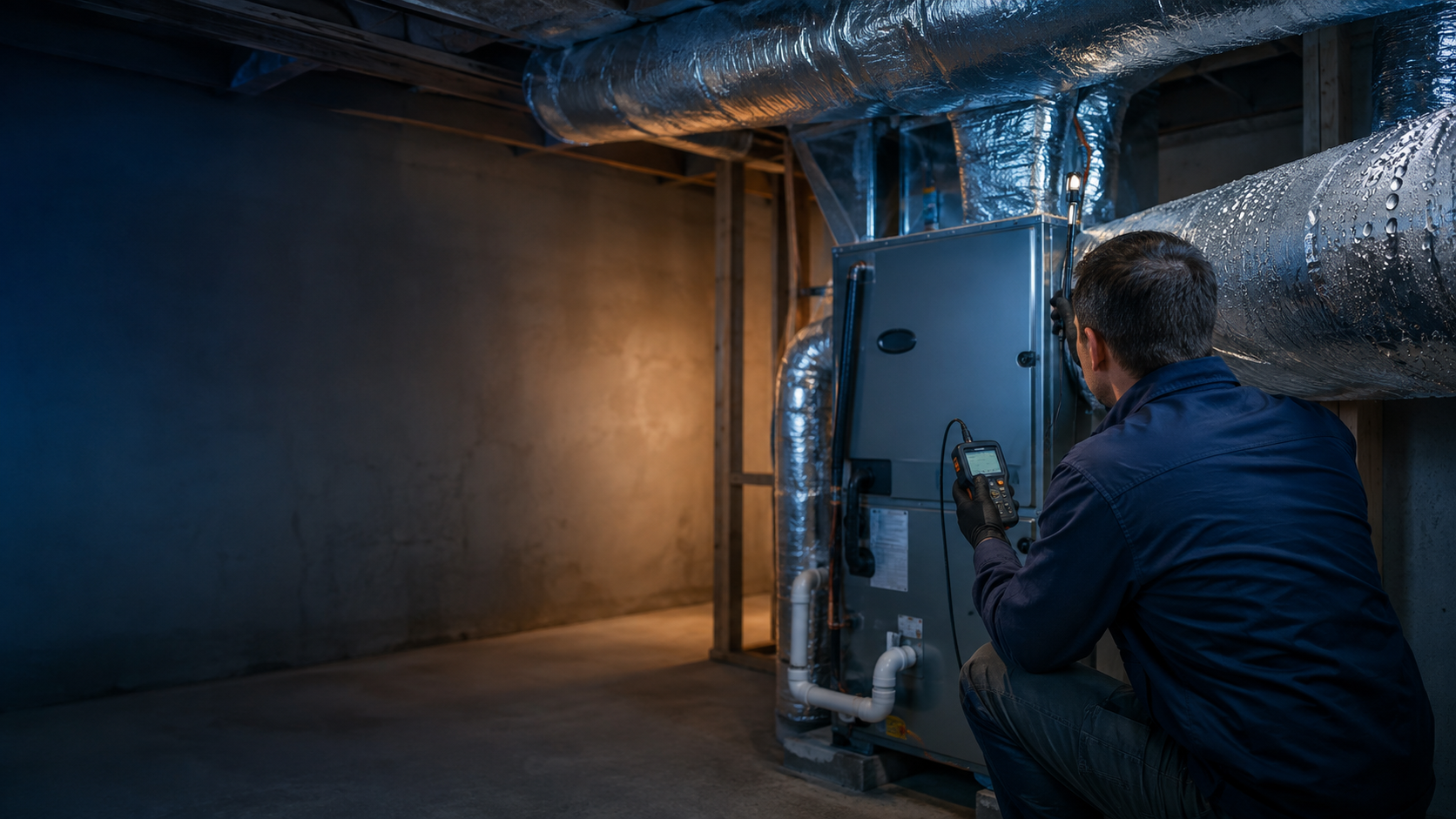
When I am looking at a sweating-vent complaint, I want to understand both the HVAC system and the environment around the duct.
Some of the things worth checking include:
- Indoor temperature
- Indoor relative humidity
- Indoor dew point
- Supply-air temperature
- Register surface temperature
- Filter condition
- Airflow across the system
- Evaporator coil condition
- Register boot insulation
- Duct insulation
- Vapor barrier condition
- Air leakage around the register boot
- Attic or crawlspace humidity
- Condensate drainage
One measurement by itself usually does not tell the entire story.
If the vent is below the surrounding air’s dew point, I know why condensation can occur.
Then the question becomes:
Why are those two conditions meeting in the first place?
What Can a Homeowner Check?
There are a few simple things homeowners can look at without opening the HVAC equipment.
Check the Filter
A severely dirty filter can contribute to airflow problems.
Use the correct filter type and size for the system.
Make Sure the Registers Are Open
Do not close a bunch of supply vents in an attempt to redirect air without understanding what that does to the duct system.
Look Around the Vent
Look for gaps around the register, water staining, damp drywall, visible insulation problems, or condensation forming only on the metal face.
Pay Attention to When It Happens
Does it only happen on very humid days?
Does it happen during long cooling cycles?
Is it only happening at one particular vent?
Or is it happening throughout the entire house?
Those details can be useful during diagnosis.
Look at Indoor Humidity
If the home is consistently running at very high indoor relative humidity, the sweating vent may be one symptom of a larger moisture problem.
When Should You Call an HVAC Professional?
A little temporary condensation around one register may not always indicate a major failure.
But recurring water should not simply be ignored.
It is a good idea to have the system inspected if:
- Water is damaging the ceiling or walls
- Multiple vents are sweating
- Indoor humidity stays unusually high
- Duct insulation is wet
- Water is coming from inside the duct
- Airflow feels weak
- The system is freezing
- The problem keeps returning
- There is enough moisture to cause staining or deterioration
Water and building materials do not mix well over time.
Even if the HVAC system itself is operating normally, repeated condensation can eventually damage insulation, drywall, wood, or metal.
The Vent Usually Is Not the Real Problem
This is probably the biggest takeaway.
The vent is often just the place where you can see the problem.
A sweating register may be telling you about indoor humidity, dew point, duct insulation, air leakage, crawlspace or attic conditions, supply-air temperature, airflow, or condensate drainage.
That is why simply wiping off the register does not solve much.
The water will come back if the conditions that created it are still there.
The Takeaway
If your AC vent is sweating, start with the basic physics.
Cold surface.
Humid air.
Dew point.
When those conditions line up, condensation forms.
The real diagnosis is figuring out why they are lining up.
Maybe indoor humidity is too high.
Maybe the register boot is poorly insulated.
Maybe humid attic air is leaking around the boot.
Maybe the duct insulation is damaged.
Maybe the surrounding crawlspace has a moisture problem.
Or maybe there is an HVAC or drainage problem that needs to be investigated.
The vent itself is often only showing you the result.
Finding the source means looking at the HVAC system and the building around it together.

Community discussion
Join the discussion.
Sign in with Google to contribute. Comments and replies appear immediately, so keep the conversation useful, respectful, and focused on the trade.
Loading comments…
No approved comments yet. Share a thoughtful question, observation, or field lesson below.
Leave a comment
Share what you’re learning.
Your Google email address is not posted or stored with the comment. Your display name and message become public immediately.
A Google account is required to reduce spam and keep comments accountable.
Your comment is now visible in the discussion.