Static pressure measures the resistance your HVAC blower works against. Learn how ducts, filters, coils, and fittings can affect airflow, comfort, noise, humidity, energy use, and equipment life.
Your HVAC system does more than heat and cool the air inside your home.
It also has to move that air.
Every time your furnace or air handler turns on, the blower has to pull air through the return side of the system, move it through the filter and indoor equipment, and then push it back through the supply ductwork to the rooms in your home.
That sounds simple enough.
But the air does not move through that system for free.
Every filter, grille, duct, elbow, fitting, coil, register, and transition creates some amount of resistance.
One of the ways we measure that resistance is called static pressure.
And if that pressure gets too high, your HVAC system may be working much harder to move air than you realize.
What Is Static Pressure?
The easiest way I know to explain static pressure to a homeowner is to think about breathing through a straw.
A large straw lets air move fairly easily.
Make the straw smaller, longer, or partially block it, and suddenly it takes more effort to move the same amount of air.
Your duct system works in a similar way.
Static pressure is essentially the resistance the blower has to work against while moving air through the HVAC system.
Carrier describes static pressure as resistance to airflow within the duct system and notes that excessive static pressure can reduce the amount of air the system actually moves.
That resistance itself is normal.
Every duct system has static pressure.
The problem is when the resistance becomes greater than the equipment was designed to handle.
What Is Static Pressure Measured In?
Static pressure in HVAC systems is usually measured in inches of water column.
You may see it written as:
in. w.c.
or sometimes:
in. wg
Both refer to a very small pressure measurement based on how far that pressure could move a column of water.
That may sound strange if you are used to seeing refrigerant pressure measured in PSI.
The pressures inside residential duct systems are much smaller, so inches of water column gives us a much more useful scale.
For example, you may see an HVAC system with a rated external static pressure around 0.50 in. w.c.
That does not mean every residential HVAC system should always measure exactly 0.50.
The correct pressure depends on the equipment, blower, airflow requirement, duct system, accessories, and manufacturer specifications.
That is why I do not like treating 0.5 inches as a universal pass-or-fail number.
The actual measurement should be compared with the blower performance information for the equipment being tested.
How Do Technicians Measure Static Pressure?
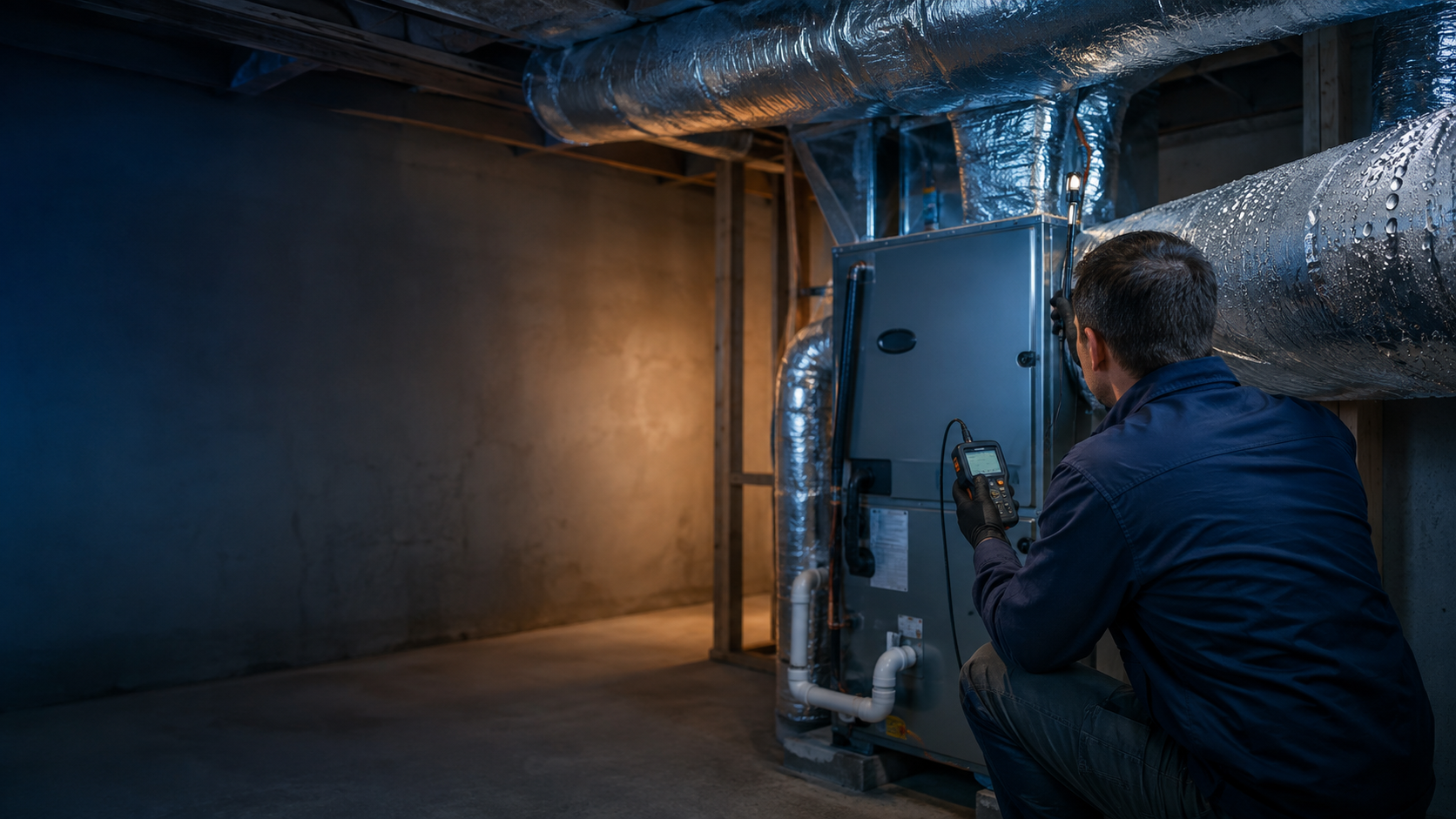
Static pressure is usually measured with an instrument called a manometer.
A technician uses small pressure probes inserted into specific locations in the duct system or equipment.
One measurement is typically taken on the return side of the blower.
Another is taken on the supply side.
Because the return side is under negative pressure and the supply side is under positive pressure, the two readings are combined by magnitude to determine what is commonly called total external static pressure, or TESP.
As a simplified example:
Return static:
-0.30 in. w.c.
Supply static:
+0.35 in. w.c.
Total external static pressure:
0.65 in. w.c.
That number can then be compared with the manufacturer's blower-performance information.
The exact test locations matter.
Depending on the equipment, filter location, coil arrangement, and manufacturer instructions, a technician needs to understand what is and is not included in the external static measurement.
That is one reason static-pressure testing is more than simply poking two holes in the duct and reading a number.
Why Does Static Pressure Matter?
Because the blower is what moves the conditioned air through your home.
If the system cannot move the amount of air it was designed to move, a lot of other things can start changing.
Trane specifically notes that high static pressure can reduce actual airflow and make the HVAC system work harder. Their residential filter guidance also connects restricted airflow with higher electrical use and potentially shorter equipment life.
That is what makes static pressure such a useful diagnostic measurement.
It gives us a way to see something homeowners cannot normally see:
How hard is the air-moving side of the system fighting to do its job?
Your Blower Can Be Running and Still Have an Airflow Problem
This is an important distinction.
A blower motor running does not automatically mean the correct amount of air is moving.
You can hear the blower.
You can feel air coming from the registers.
The motor may even be running at a high speed.
And the system can still have an airflow problem.
If the duct system has excessive resistance, the blower has to operate against that restriction.
How the system responds depends partly on the type of blower motor.
Different Blower Motors React Differently
Older HVAC equipment commonly used PSC motors.
As the static pressure increases, these motors generally lose airflow.
In simple terms, the harder the duct system becomes to breathe through, the less air the blower may actually move.
Modern equipment commonly uses some form of ECM, or electronically commutated motor.
These motors can respond differently.
Some ECM systems can increase motor speed or output in an attempt to maintain the programmed airflow as static pressure changes.
Carrier, for example, describes communicating variable-speed constant-airflow ECM systems that are designed to maintain airflow as external static pressure changes.
That sounds great, and it is useful technology.
But it does not mean the duct system no longer matters.
If the blower has to keep increasing its effort because the system is too restrictive, that extra work still has consequences.
High Static Pressure Can Mean More Blower Work
This is one of the biggest reasons I think homeowners should understand static pressure.
Imagine two identical HVAC systems.
One has a duct system that allows air to move relatively easily.
The other has undersized ducts, a restrictive filter, or several other airflow restrictions.
Both systems may eventually cool the house.
But the second blower may have to work much harder to do it.
On certain ECM systems, the motor may increase its output to try to maintain airflow.
That can increase electrical consumption and blower workload.
Clogged filters can restrict airflow, force the system to work harder, increase electricity use, and potentially shorten fan-motor life.
So something that looks like a simple duct or filter problem can eventually become an equipment problem too.
What Can Excessive Static Pressure Affect?
The blower is connected to almost everything happening on the indoor side of the HVAC system.
If airflow becomes too low or the blower has to operate under excessive resistance, you can start seeing problems in several areas.
Comfort
Rooms may not receive the airflow they need.
Some rooms may feel warmer or colder than others.
You may notice weak airflow from certain registers.
Noise
High air velocity through restrictive filters, grilles, registers, or undersized ductwork can create whistling or rushing-air noises.
Sometimes a noisy HVAC system is not actually a blower problem.
It is an airflow-resistance problem.
Energy Consumption
If an ECM blower continually increases its effort to maintain airflow, the motor can consume more power.
Carrier specifically connects airflow restriction with increased electrical consumption.
Humidity Control
Airflow also affects how the evaporator coil performs.
Trane and Carrier both promote variable-speed blower operation partly because more precise airflow control can improve humidity management and comfort.
Static pressure is therefore connected to the humidity conversation too.
It is not the only thing that determines humidity control, but the air has to move correctly across the equipment for the system to perform the way it was designed.
Heating and Cooling Performance
The furnace, heat pump, or air conditioner was designed around a certain amount of airflow.
Change that airflow significantly and operating temperatures can change as well.
On the cooling side, poor airflow can affect evaporator temperature and refrigeration-system behavior.
On the heating side, insufficient airflow can contribute to excessive temperature rise across a furnace.
That is why I do not like looking at the refrigeration system or heating system without also thinking about the air side.
They affect each other.
What Can Cause High Static Pressure?
This is where the subject can get much deeper than one article.
There are a lot of possible causes.
Some of the more common ones include:
- Dirty filters
- Filters that are too restrictive for the existing duct system
- Undersized return ductwork
- Undersized supply ductwork
- Restrictive return grilles
- Dirty evaporator coils
- Closed or blocked registers
- Crushed or poorly installed flexible duct
- Excessively long duct runs
- Restrictive fittings and transitions
- Poor duct-system design
Carrier specifically lists dirty filters and undersized ducts as examples of conditions that can create high static pressure.
And Trane emphasizes that ductwork needs to be properly installed, sealed, and insulated so the HVAC system can distribute conditioned air efficiently.
But identifying where the restriction is located deserves its own conversation.
For this article, the important point is that high total static pressure tells us:
The blower is fighting more resistance than we expected.
The next step is figuring out why.
Your Filter Can Be Part of the Problem
Filters deserve special attention because homeowners interact with them more than almost any other HVAC component.
A dirty filter can absolutely create additional resistance.
But there is another side to this.
A brand-new filter can also be restrictive.
That does not mean high-efficiency filtration is bad.
It means the filter, filter cabinet, duct system, and blower all need to work together.
That is why simply buying the filter with the highest number on the package is not always the whole answer.
The system has to be able to move air through it.
A clogged filter restricts airflow, makes the system work harder, and can affect comfort, efficiency, and reliability.
Why I Like Static Pressure as a Diagnostic Tool
A lot of HVAC problems can feel subjective.
“The airflow feels weak.”
“The system seems louder.”
“The upstairs doesn't cool very well.”
“The new system doesn't feel like the old one.”
Static pressure gives us an actual measurement.
Instead of saying:
“The ductwork looks a little small.”
we can measure what the blower is experiencing.
Then we can compare that measurement with the equipment's performance information.
That gives us somewhere to start.
And once we know total static pressure, we can go further by measuring pressure drops across individual components to see where resistance is occurring.
For example:
Across the filter.
Across the evaporator coil.
Across other accessories.
That can help turn:
“You have an airflow problem.”
into:
“Here is where a significant amount of the resistance is occurring.”
That is a much more useful diagnosis.
Static Pressure Does Not Tell Us Everything About Airflow
There is one important thing I want to make clear.
Static pressure and airflow are related, but they are not the same measurement.
Static pressure tells us about resistance.
Airflow is usually expressed in CFM—cubic feet per minute.
CFM is the volume of air circulated in one minute, and static pressure is one of the factors that affects the actual CFM a system can deliver.
To really understand an airflow problem, a technician may need to combine:
- Static-pressure measurements
- Manufacturer blower tables or performance data
- Airflow measurements
- Temperature measurements
- Duct-system inspection
- Filter and coil pressure drops
That is why I think airflow deserves its own article.
There is a lot more to talk about than just static pressure.
What Should a Homeowner Take Away From This?
You do not need to own a manometer.
You do not need to know how to calculate duct friction rate.
And you definitely do not need to start drilling test ports into your furnace.
But if your home has problems like:
- Weak airflow
- Noisy vents
- Uneven temperatures
- Frequent blower problems
- Poor humidity control
- Very restrictive filters
- Rooms that are consistently uncomfortable
then the air-moving side of the system deserves attention.
One of the questions you can ask your HVAC technician is:
“Have you checked the system's static pressure?”
It is a simple measurement that can provide a lot of information.
The Takeaway
Your HVAC blower is designed to move a certain amount of air through the system.
The ductwork, filters, coil, grilles, registers, and fittings all create resistance to that airflow.
Some resistance is normal.
Too much is a problem.
Static pressure gives us a way to measure that resistance.
And when static pressure is excessive, the effects can show up as more than just weak airflow.
It can affect:
Comfort.
Noise.
Energy use.
Humidity control.
Heating and cooling performance.
Blower workload.
Equipment reliability.
The blower may still be running.
The air may still be coming out of the vents.
The house may even eventually reach the thermostat setting.
But that does not necessarily mean the air side of the system is healthy.
Sometimes the system is getting the job done by working much harder than it should.
And static pressure is one of the measurements that helps us see that.

Community discussion
Join the discussion.
Sign in with Google to contribute. Comments and replies appear immediately, so keep the conversation useful, respectful, and focused on the trade.
Loading comments…
No approved comments yet. Share a thoughtful question, observation, or field lesson below.
Leave a comment
Share what you’re learning.
Your Google email address is not posted or stored with the comment. Your display name and message become public immediately.
A Google account is required to reduce spam and keep comments accountable.
Your comment is now visible in the discussion.